
Top Laser Safety Curtains: Essential Protection for Every Workspace
2026-06-08
Laser technology drives innovation across industries, but it also brings serious hazards that demand robust safeguards. If you're searching for reliable protection, LASERPAIR laser safety curtains stand out as a top-tier solution. In this post, we'll explore what makes them essential for every workspace—from workshops to high-tech labs—and why you should consider upgrading your safety setup today.
Beyond Basic Barriers: The True Value of Laser Safety Curtains
Laser safety curtains offer far more than a simple physical barrier between personnel and hazards. Their non-contact guarding design allows materials and workers to move freely through protected zones without the repetitive stop-start cycles associated with mechanical gates. This uninterrupted flow streamlines production tasks such as loading, inspection, and assembly, trimming cycle times while leaving safety integrity intact. The ability to dynamically reshape protected areas through software rather than hard fixtures means a single system can adapt to multiple product lines or workflows, providing a level of agility that conventional fencing simply cannot match.
Beyond passive guarding, these systems anchor deeper value through intelligent integration. Real-time condition monitoring and bidirectional communication with machine controls enable predictive maintenance alerts and granular safety diagnostics that prevent unplanned outages. In collaborative settings where operators must frequently interact with automation, the invisible detection plane reduces physical strain and cognitive load, fostering a smoother human-machine interface. This blend of protection, productivity insight, and ergonomic support transforms a safety component into a strategic asset that actively contributes to both uptime and process optimization.
Material Matters: What Makes a Curtain Truly Laser-Safe
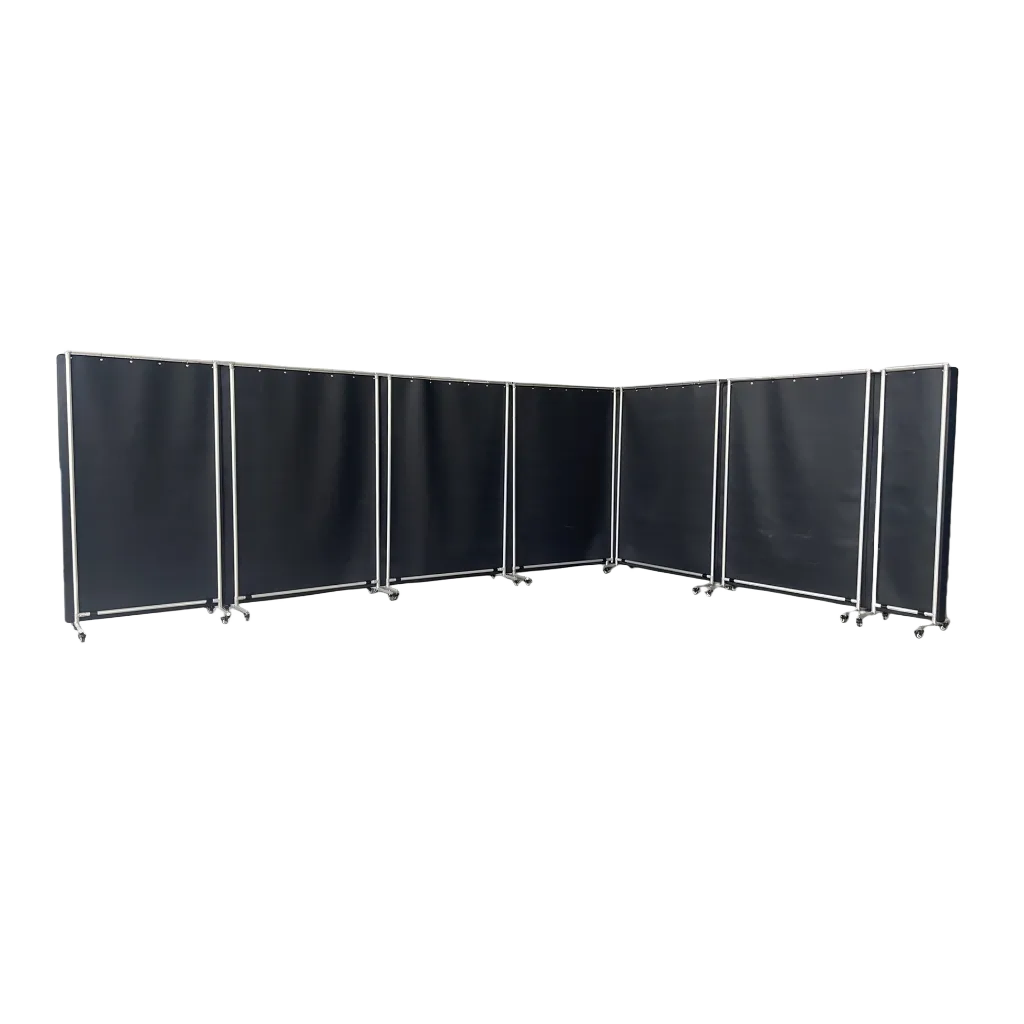
Step into any workshop using laser cutters or engravers, and you’ll quickly notice that standard fabric curtains are a non‑starter. The energy from a Class 4 laser can pass right through ordinary textiles, igniting them within seconds or allowing scattered radiation to reach unprotected eyes. True laser safety isn’t just about blocking visible light—it’s about absorbing and containing invisible near‑infrared or ultraviolet wavelengths that many common materials can’t stop. Even tightly woven cotton or polyester blends offer little resistance, making material choice the first line of defense.
So what works? Heavy‑duty PVC films, often amber or green‑tinted, are a popular starting point because they’re inherently rigid and can be infused with specific light‑blocking pigments. These additives give the curtain a defined optical density, usually rated at OD 4+ for typical diode or CO₂ laser wavelengths, meaning only 0.01% of light passes through. However, pure PVC alone may degrade under prolonged exposure, so many manufacturers laminate it with a polycarbonate core or a flame‑retardant mesh. The result is a flexible yet durable shield that won’t warp, melt, or contribute to a fire. Some advanced solutions even employ multi‑layer nano‑composites that self‑extinguish if accidentally hit by a beam, combining passive filtration with active safety. The key lies in matching the curtain’s spectral attenuation curve to your specific laser equipment—a detail that separates a genuinely safe enclosure from a risky afterthought.
Industry Snapshots: Where These Curtains Prove Essential
In busy restaurant kitchens, heavy-duty strip curtains stand guard between cooking zones and storage areas, keeping heat in check while allowing staff to push through smoothly with laden trays. The flexible yet durable PVC strips absorb the constant traffic without degrading, a silent ally in the chaos of dinner service.
Cold storage facilities rely on these barriers to maintain strict temperature zones. Imagine a loading bay where the icy fog spills out every time a door opens—transparent overlapping strips cut that waste dramatically, creating an open yet thermally efficient passage for forklifts and workers. It’s a simple solution that shaves energy costs without slowing down operations.
Even automotive spray booths depend on anti-static curtains to contain overspray and contaminants. The strips create a nearly sealed environment while sustaining visibility, ensuring a flawless paint job. In each setting, these curtains fade into the background, yet their absence would bring operations to a jarring halt.
A Smarter Selection: Tailoring Your Choice to Laser Type
Laser systems diverge sharply in their material affinities. Fiber lasers, with their concentrated beam, bite into metals without hesitation, whereas CO₂ tubes slice through wood and acrylic as if they were butter. Skipping this fundamental match means wasted power, ruined stock, and a machine that’s perpetually out of its depth.
The wavelength matters just as much as raw wattage. A UV source’s shorter wavelength leaves glass and delicate polymers unscathed, sidestepping the thermal chaos that longer-wavelength units often bring. Meanwhile, if your workflow revolves around high-contrast marking on anodized aluminum, a fiber system’s pulse control becomes the quiet workhorse you didn’t know you needed.
Operating costs tend to creep up unexpectedly. Diode lasers promise lower electric bills and a no-fuss air-cooled life, but they struggle where a CO₂’s sustained cutting rhythm shines. Balancing these practicalities—beam quality, consumable life, and the kind of fume extraction your materials demand—ensures the selection isn’t just smart on paper, but a genuine fit for the shop floor.
Setting Up for Success: Installation Insights
Getting your system running smoothly starts with an often-overlooked step: environment preparation. Before you even download the package, take a moment to check dependencies and version compatibility. A subtle mismatch between your operating system and a key library can lead to hours of silent troubleshooting. I've learned to always run a quick pre-install scan—something like verifying system paths or confirming runtime versions—because those small checks save you from cryptic error messages later on.
When it’s time to actually install, resist the urge to blindly follow default settings. Custom configurations, while intimidating at first, let you tailor placements and feature sets to your specific workflow. I remember a project where overriding the default directory structure kept our deployment scripts portable across different machines. It’s also worth isolating installations in self-contained environments whenever possible—think virtual environments or containers—to avoid dependency hell and make rollbacks painless.
Finally, don’t close the terminal right after a success message. Verify the installation with real-world sanity checks. Launch a quick test script that exercises core functionality, not just the "hello world" example. Pay attention to output logs and permissions; a functioning installation that silently fails on restricted directories can derail collaboration. Taking these extra minutes turns a routine setup into a foundation you can actually rely on.
Long-Term Performance: Care That Makes a Difference
Durability isn’t just a feature—it’s a promise that unfolds over time. When materials are chosen with precision and craftsmanship is prioritized, the result is a product that withstands wear without losing its character. This philosophy drives us to focus on every stitch, seam, and surface, ensuring that what you invest in today still feels exceptional years from now.
But true longevity goes beyond physical resilience. It’s about how a well-made piece adapts to your life, aging gracefully while maintaining its core integrity. Through meticulous design, we create items that develop a unique patina, telling a story that becomes more personal with each passing season. This approach rejects disposable culture, opting instead for enduring quality that reduces the need for frequent replacements.
Ultimately, long-term performance is rooted in a deeper kind of care—one that considers the full lifecycle of a product. From sustainable sourcing to repairable construction, every decision is made with the future in mind. This means supporting you not just at the point of purchase, but through years of use, with service and guidance that keep your purchase performing brilliantly as the world changes around it.
FAQ
They're engineered barriers specifically built to block or significantly weaken laser radiation, using materials with precise optical density ratings for specific wavelengths. Unlike standard industrial dividers, they're not just for physical separation—they actively neutralize dangerous light energy to prevent eye injuries or burns.
As lasers become more common in manufacturing, medical settings, and research, so does the risk of accidental beam exposure. These curtains offer a flexible, semi-permanent way to cordon off hazardous zones without sacrificing layout adaptability, effectively turning open floors into safer, compliant environments.
Optical density is a measure of how much laser light the curtain stops. A higher OD means greater attenuation; OD 5 allows only 0.001% transmission. The right number depends on your laser’s power and wavelength—choosing too low leaves risk, while overkill may waste budget.
Yes, and they’re highly diversified. You’ll encounter curtains tuned for ultraviolet, visible, or infrared spectrums. Formats range from roll-up vinyl sheets to rigid composite panels. Some even combine reflective and absorptive layers to handle multiple laser sources at once.
Start by matching the curtain’s protection curve to your laser’s peak wavelength and maximum output. Then factor in environmental demands—does the workspace require flame retardancy, static dissipation, or chemical resistance? Mounting style and coverage area geometry are equally critical to avoid unprotected gaps.
Durability varies by construction, but top-tier models use photostable dyes or robust reflective films bonded to resilient backings. Under normal use, they can remain effective for years. However, mechanical wear, soiling, or exposure beyond their rated limit can reduce performance, so periodic checks are wise.
Many off-the-shelf systems with ceiling tracks or portable stands are straightforward for in-house assembly. That said, complex enclosures or integration with interlock systems often benefit from a manufacturer’s installation service to guarantee full compliance and beam-tight seals.
Conclusion
Laser safety curtains do far more than block stray beams—they redefine how workspaces manage risk without sacrificing visibility or workflow. The real value lies in their ability to create a controlled optical zone, absorbing and containing specific wavelengths rather than just acting as a physical wall. This performance hinges entirely on material science: multilayered fabrics infused with flame‑retardant additives and wavelength‑specific absorbers are what make a curtain truly laser‑safe. From industrial cutting floors to delicate medical aesthetics rooms and university optics labs, the right curtain becomes essential when open beam paths intersect with human activity. Selecting the appropriate model means matching both the laser’s wavelength and power density to the curtain’s optical density rating, ensuring no harmful transmission even during accidental long‑term exposure.
A curtain’s protective promise, however, is only as strong as its installation and continued care. Proper mounting eliminates gaps that can leak radiation, while ground‑connected frames prevent static buildup that degrades optical filters over time. Routine inspection for surface damage, discoloration, or contamination is not just housekeeping—it directly impacts attenuation performance. When integrated with interlock systems and regular cleaning protocols, these barriers quietly deliver decades of dependable protection. In any setting where intense light sources are part of the daily routine, top‑tier laser safety curtains transform from an optional accessory into an irreplaceable safeguard for both people and precision processes.
Contact Us
Contact Person: Jenny
Email: [email protected]
Tel/WhatsApp: +86 13537713281
Website: https://www.laserpair-safety.com/